Peak Health home > Plants > Serpentine Barren Endemics
Why Was This Indicator Chosen?
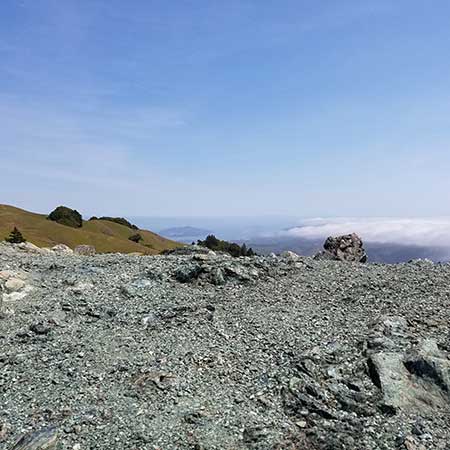
Serpentinite, California’s state rock, creates serpentine soils, which are characterized by low amounts of calcium, high amounts of magnesium, relatively heavy concentrations of nickel, chromium and other heavy metals, and low levels of nitrogen (USDA, 2016). Only certain plant species are able to survive in these soils. Serpentine is a rare soil type statewide, further limiting the distribution of plants that are specifically adapted to its characteristics.
Serpentine barrens are characterized by open, rocky soil. They support mostly scattered annuals such as jewel flowers, rosinweed (Calycadenia multiglandulosa), navarretias, and a few perennial plants such as lomatiums, and buckwheats. Many rare and locally rare, and Mt. Tam endemic plants may also be found within these areas. Approximately half of Mt. Tam's rare plants—by both number of taxa and number of populations—are serpentine endemics. This report assessed only endemic annuals.
What is Healthy?
Four serpentine endemic annual species persist, with strong populations across their current range:
- Mt. Tamalpais bristly jewelflower (Streptanthus glandulosus ssp. pulchellus) is present, with abundance reflecting 2016–2022 goals in six of nine revisited barrens.
- Tiburon buckwheat (Eriogonum luteolum var. caninum) is present, with abundance reflecting 2016–2022 goals in eight revisited barrens.
- Marin navarretia (Navarretia rosulate) is present, with abundance reflecting 2016–2022 goals in five revisited barrens.
- Tamalpais jewelflower (Streptanthus batrachopus) is present, with abundance reflecting 2016–2022 goals in three revisited barrens.
In addition, two species, Marin dwarf flax (Hesperolinon congestum) and Tamalpais lessingia (Lessingia micradenia), meet recovery goals set by the U.S. Fish and Wildlife Service (1998).
What Are the Biggest Threats?
- Non-native barbed goatgrass (Aegilops triuncialis), purple false brome (Brachypodium distachyon), and cheatgrass (Bromus tectorum) occur in or adjacent to approximately half of the inventoried barrens
- Lack of fire may allow native trees, shrubs, or grasses to overtake open areas
- Development on serpentine barren habitats inside the area of focus, including the Mill Valley Air Force Station at West Peak
- Trampling by recreationists
- Limited areas for migration under future climate change scenarios due to the relative rarity of serpentine soils
- Atmospheric nitrogen deposition, which can cause increased annual grass growth in serpentine barrens, which reduces open spaces and crowds out diminutive annual forbs restricted to these open areas
What is The Current Condition?
The overall condition is Fair.
In 2016, thresholds were not set, so species were considered in good condition based on Marin Water inventories at that time. New data (see below) allowed thresholds to be established in 2022. Based on these thresholds, Mt. Tamalpais bristly jewelflower only falls below good condition in two barrens with five years of data, and Tiburon buckwheat in three. Tiburon buckwheat falls to the significant concern threshold in one barren. Occupancy thresholds have been met for both species. The dataset does not yet have five years of monitoring data for Marin navarretia and Tamalpais jewelflower in all occupied barrens. Marin navarretia appears very stable in two barrens with five years of data, but declined to caution in another barren; a 15% decrease was detected in a barren with three years of data. Tamalpais jewelflower declined to caution in two of three occupied barrens.
Marin dwarf flax has two small populations in the area of focus, with one having fewer than 200 plants observed during the survey period. Tamalpais lessingia is extant on 42 of 99 barrens, for a total of three populations; one revisited barren contains Tamalpais lessingia where it has remained stable over the time period of the current dataset.
What is the Current Trend?
Overall, this community has a trend of No Change. Populations of the more common rare plant species have not changed (Mt. Tamalpais bristly jewelflower and Tiburon buckwheat), but the rarer ones appear to be in decline (Marin navarretia and Tamalpais jewelflower).
How Sure Are We?
We have Moderate confidence in this assessment. New data on serpentine barren occupancy and species abundance from the One Tam Serpentine Endemic Occupancy Project (initiated in 2016) are now available and have been used to inform this update. This allows us to set baselines, condition goals, and condition and trend thresholds for each metric, something that was not possible in 2016.
What is This Assessment Based On?
- Serpentine Endemic Occupancy Project (2019)
- Marin Water rare plant surveys (2009–2016)
- California Natural Diversity Database data for certain species (2016)
- Serpentine barrens visible on aerial imagery
What Don’t We Know?
Key information gaps include:
- If “barren” patch size influences rare species composition or occupancy resilience, or if patches need to be subsampled or rotationally sampled to determine health of the whole system
- Where suitable areas for population augmentation might exist
resources
Ackerly, D. D., Ryals, R. A., Cornwell, W. K., Loarie, S. R., Veloz, S., Higgason, K. D., Silver, W. L., & Dawson, T. E. (2012). Potential impacts of climate change on biodiversity and ecosystem services in the San Francisco Bay Area (Publication no. CEC-500-2012-037). Prepared for California Energy Commission. https://escholarship.org/uc/item/1qm749nx
California Department of Fish and Wildlife [CDFW]. (2009). California natural diversity database. Retrieved July 13, 2016, from https://www.wildlife.ca.gov/Data/CNDDB
Fenn, M. E., Allen, E. B., Weiss, S. B., Jovan, S., Geiser, L. H., Tonnesen, G. S., Johnson, R. F., Rao, L. E., Gimeno, B. S., Yuan, F., Meixner, T., & Bytnerowicz, A. (2010). Nitrogen critical loads and management alternatives for N-impacted ecosystems in California. Journal of Environmental Management, 91(12), 2404–2423. doi: 10.1016/j.jenvman.2010.07.034
Golden Gate National Parks Conservancy [GGNPC], Tukman Geospatial, & Aerial Information Systems. (2021). 2018 Marin County fine scale vegetation map datasheet. Tamalpais Lands Collaborative (One Tam). https://tukmangeospatial.egnyte.com/dl/uQhGjac1zw
U.S. Fish and Wildlife Service [USFWS]. (1998). Recovery plan for serpentine soil species of the San Francisco Bay Area. http://ecos.fws.gov/docs/recovery_plan/980930c_v2.pdf
U.S. Forest Service [USFS]. (n.d.). Serpentine soils and plant adaptations. https://www.fs.usda.gov/wildflowers/beauty/serpentines/adaptations.shtml
Weiss, S. B. (2006). Impacts of nitrogen deposition on California ecosystems and biodiversity (Publication No. CEC-500-2005-165). Prepared for California Energy Commission. https://creeksidescience.files.wordpress.com/2012/01/weiss_2006_nitrogen.pdf