Peak Health home > Plants > Sargent Cypress
Why Was This Indicator Chosen?
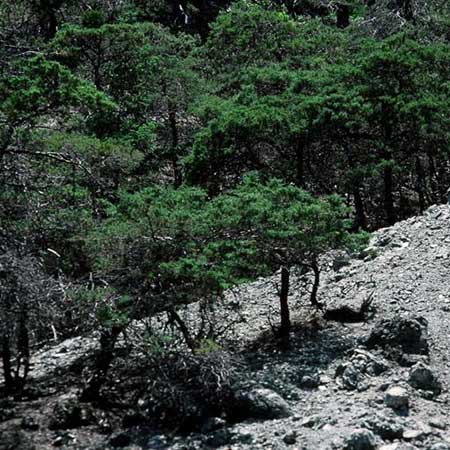
Sargent cypress (Hesperocyparis sargentii) communities occur as open, scrubby forests and woodlands associated with serpentine chaparral. They are relatively limited in distribution and globally rare (LCA, 2009). The “pygmy forest” of Sargent cypress along San Geronimo Ridge is a rare vegetation type that hosts several California Native Plant Society-listed and locally rare plant species.
These communities are good indicators of wildfire and mechanical disturbance. Sargent cypress stands typically recruit new trees following stand-replacing wildland fires, making this a key disturbance process for their long-term persistence. A combination of shade and the properties of serpentine soils make these communities relatively resistant to weed invasion, with the exception of disturbance created by roads, trails, and fuel breaks, which can create a point of entry for some invasive species (LCA, 1995).
The One Tam area of focus includes all Sargent cypress habitat in Marin County (451 acres), all of which is found on Marin Water- and Marin County Parks-managed lands (GGNPC et al., 2021a).
What is Healthy?
- Sargent cypress community acreage remains stable
- Species richness or structural diversity remains stable
- Natural recruitment of Sargent cypress
- Minimal presence of invasive species
What Are the Biggest Threats?
- A lack of fire, which plays a critical role in new tree recruitment by stimulating seed dispersal from serotinous cones and creating the bare soil conditions Sargent cypress seedlings need to establish
- Road grading or mowing impacts to trees growing along the shoulder, and invasion by non-native species associated with roads, trails and fuel breaks
- Douglas-fir (Pseudotsuga menziesii) encroachment, though this is less likely to occur in serpentine areas, as Douglas-fir is not as tolerant of those soil types
What is The Current Condition?
The overall condition is Good. The mapped extent of Sargent cypress communities in the One Tam area of focus is greater than 95% of that mapped in 2016, and there has been no loss of patches. Unlike many of the other communities chosen as indicators, Sargent cypress appears to be relatively disease- and weed-free, and may expand its range in the face of stressors that negatively affect other dominant plant species. Sargent cypress plant communities are typically stable for decades, then experience a complete reset after high-intensity fire. There have been no fires in Sargent cypress habitats in the One Tam area of focus since the 2016 report, and so, as expected, they have experienced no major changes.
What is the Current Trend?
The current trend is No Change. Trends for recruitment levels and invasive species cover are unknown.
How Sure Are We?
We have High confidence in the 2022 assessment, which increased from 2016, because invasive species presence was field-assessed in 2022.
What is This Assessment Based On?
- Marin Water’s original 2004 vegetation map, which was updated in 2009 and 2014 to track the progression of Sudden Oak Death tree disease (GGNPC et al., 2021b)
- Marin County Parks 2008 vegetation map, created with a methodology similar to that used by Marin Water (Aerial Information Systems, 2008)
- Marin Countywide Fine Scale Vegetation Map, 2018
What Don’t We Know?
Key information gaps include:
- Impact of Fire in the Current Climate: In the decades after the next large fire, the fine-scale vegetation map should be periodically redone to assess the fire’s impact on the extent and regeneration of Sargent cypress communities.
resources
Aerial Information Systems [AIS]. (2008). Marin County open space district vegetation photo interpretation and mapping classification report. Prepared for Marin County Parks.
Aerial Information Systems [AIS]. (2015). Summary report for the 2014 photo interpretation and floristic reclassification of Mt. Tamalpais watershed forest and woodlands project. Prepared for Marin Municipal Water District.
Bartel, J. A. (2012). Hesperocyparis sargentii. Jepson eFlora [Online]. Retrieved July 13, 2022, from https://ucjeps.berkeley.edu/eflora/eflora_display.php?tid=89302
California Department of Fish and Wildlife [CDFW]. (2022). Sensitive natural communities (Updated July 5, 2022). https://www.wildlife.ca.gov/Data/VegCAMP/Natural-Communities
Dawson, A. (2021). Marin County wildfire history mapping project. Marin forest health strategy [In preparation]. Tamalpais Lands Collaborative (One Tam).
Esser, L. L. (1994). Hesperocyparis sargentii: Fire effects information system (FEIS) [Database]. U.S. Department of Agriculture. Retrieved July 20, 2022, from https://www.fs.usda.gov/database/feis/plants/tree/hessar/all.html
Evens, J., Kentner, E., & Klein, J. (2006). Classification of vegetation associations from the Mount Tamalpais watershed, Nicasio Reservoir, and Soulajule Reservoir in Marin County, California [Technical report]. California Native Plant Society and Marin Municipal Water District.
Golden Gate National Parks Conservancy (GGNPC), Tukman Geospatial & Aerial Information Systems. (2021a). 2018 Marin County fine scale vegetation map datasheet. Tamalpais Lands Collaborative (One Tam). https://tukmangeospatial.egnyte.com/dl/uQhGjac1zw
Golden Gate National Parks Conservancy (GGNPC), Tukman Geospatial & Aerial Information Systems. (2021b). Standardized 2004–2014 county parks/Marin Water vegetation map [Data set]. Golden Gate National Parks Conservancy. https://vegmap.press/marin_standardized_04_14_datasheet
International Union for Conservation of Nature [IUCN]. (2016). IUCN red list of threatened species: Cupressus sargentii [Data file]. Retrieved [n.d.] from http://www.iucnredlist.org/details/42258/0
Johnstone, J. A., & Dawson, T. E. (2010). Climatic context and ecological implications of summer fog decline in the coast redwood region. Proceedings of the National Academy of Sciences, 107(10), 4533–4538. https://doi.org/10.1073/pnas.091506210
Kurz, W. A., Dymond, C. C., Stinson, G., Rampley, G. J., Neilson, E. T., Carroll, A. L., Ebata, T., & Safranyik, L. (2008). Mountain pine beetle and forest carbon feedback to climate change. Nature, 452(7190), 987–990. https://doi.org/10.1038/nature06777
Lanner, R. M. (1999). Conifers of California. Cachuma Press.
Leonard Charles & Associates [LCA]. (1995). Mt. Tamalpais area vegetation management plan. Prepared for Marin Municipal Water District.
Leonard Charles & Associates [LCA]. (2009). Biodiversity management plan for Marin Municipal Water District lands. Prepared for Marin Municipal Water District.
Linnakoski, R., De Beer, Z. W., Niemelä, P., & Wingfield, M. J. (2012). Associations of conifer-infesting bark beetles and fungi in Fennoscandia. Insects, 3(1), 200–227. https://doi.org/10.3390/insects3010200
Ne’eman, G., Fotheringham, C. J., & Keeley, J. E. (1999). Patch to landscape patterns in post-fire recruitment of a serotinous conifer. Plant Ecology, 145(2), 235–242. https://doi.org/10.1023/A:1009869803192
Panorama Environmental. (2019). Marin Municipal Water District biodiversity, fire and fuels integrated plan. Prepared for Marin Municipal Water District. https://tinyurl.com/2z9nxu2w
Safford, H., & Miller, J. E. (2020). An updated database of serpentine endemism in the California flora. Madroño, 67(2), 85–104. https://doi.org/10.3120/0024-9637-67.2.85
Thorne, J. H., Choe, H., Boynton, R. M., Bjorkman, J., Albright, W., Flint, A. L., Flint, L. E., & Schwartz, M. W. (2017). The impact of climate uncertainty on California’s vegetation and adaptation management. Ecosphere, 8(12), e02021. https://doi.org/10.1002/ecs2.2021
Tukman Geospatial, Aerial Information Systems, & Kass Green & Associates. (2021). Accuracy assessment. In 2018 Marin countywide fine scale vegetation map, Tamalpais Lands Collaborative (One Tam) (Final report, pp. 47–59). Prepared for Golden Gate National Parks Conservancy. https://vegmap.press/marin_report_w_aa
Van de Water, K. M., and Safford, H. D. (2011). A summary of fire frequency estimates for California vegetation before Euro-American settlement. Fire Ecology, 7(3), 26–58. https://doi.org/10.4996/fireecology.0703026