Peak Health home > Landscapes > Ecosystems > Coast Redwood Communities
Summary
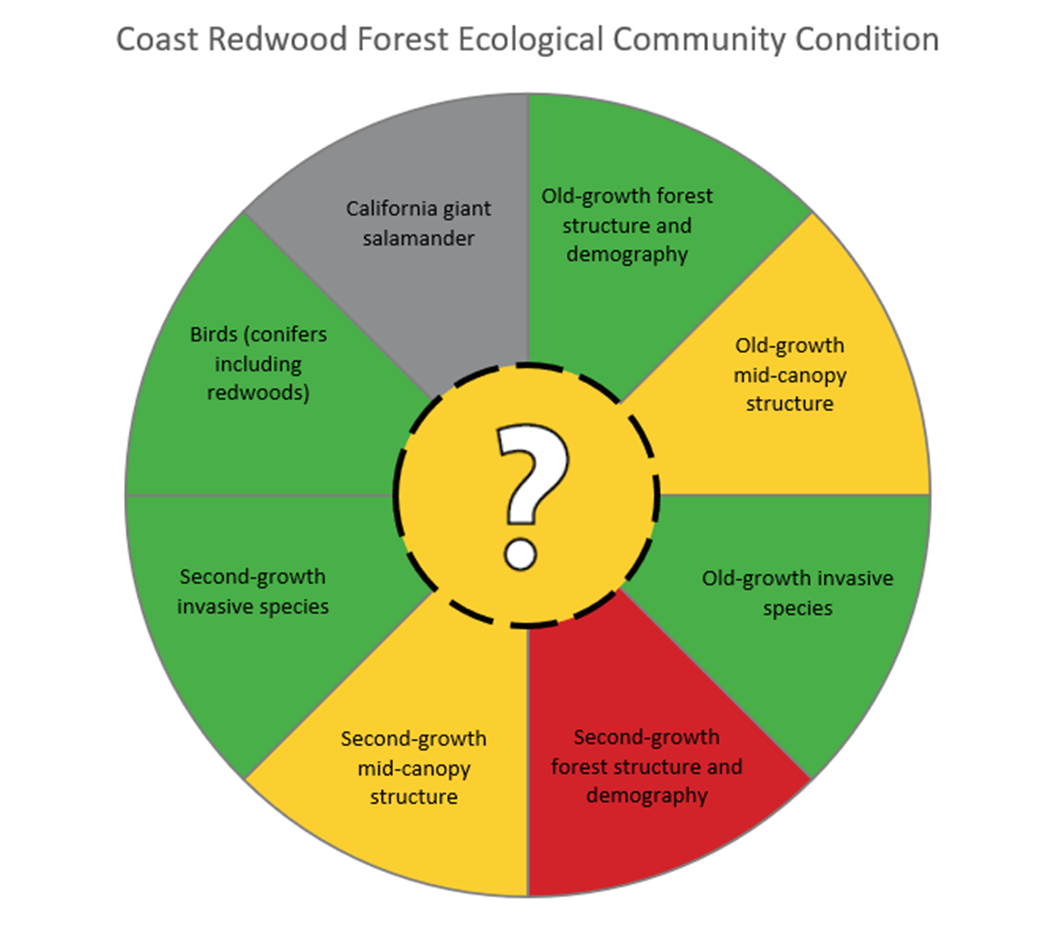
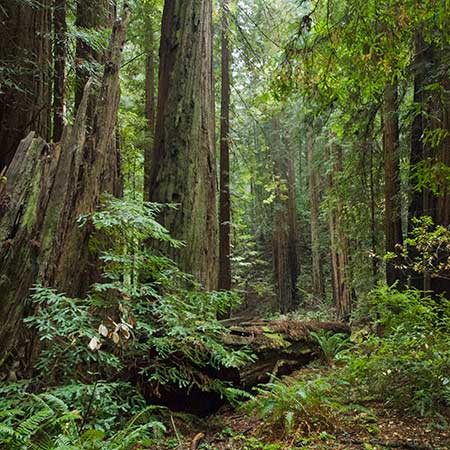
While old-growth redwood forests are in Good condition, the condition of second-growth forests, which make up the majority of these communities on Mt. Tam, is Caution. Second-growth forests are largely a result of historical logging in the area. Although they vary widely in their characteristics and in the degree to which they have recovered from the impacts of logging, Mt. Tam’s second-growth stands generally exhibit a greatly simplified structure: an absence of larger trees in the canopy, a more basic understory, and a higher density of small-diameter trees.
Forest Disease
Currently, SOD is the major stressor of both old- and second-growth forest structure, particularly its impact on tanoaks, which are common redwood-forest understory associates. Estimates across Marin County put total tanoak mortality at about 50% or greater (McPherson et al., 2010; Swiecki & Bernhardt, 2013). In many stands within the One Tam area of focus, close to 100% of the tanoaks have been affected.
Animals
An assessment of the avian community associated with coast redwood forests indicates that it is in good condition; Northern Spotted Owls (Strix occidentalis caurina) are doing well across the region in this habitat type.
Climate Change
The fate of Marin County’s redwood forests may very much depend on whether climate change produces overall wetter or drier conditions. Bay Area redwoods occupy relatively low climatic-water-deficit zones, but as water deficits increase, some populations currently near the drier edge of the range could end up in unsuitable conditions. A statewide model of climate exposure suggests that about 45% of redwood forests in the One Tam area of focus are in a “high exposure” category and thus may not be able to adapt (Thorne et al., 2017; GGNPC et al., 2021).
resources
McPherson, B. A., Mori, S. R., Wood, D. L., Kelly, M., Storer, A. J., Svihra, P., & Standiford, R. B. (2010). Responses of oaks and tanoaks to the sudden oak death pathogen after 8 years of monitoring in two coastal California forests. Forest Ecology and Management, 259(12), 2248–2255. https://doi.org/10.1016/j.foreco.2010.02.020
Swiecki, T. J., & Bernhardt, E. A. (2013). Long-term trends in coast live oak and tanoak stands affected by Phytophthora ramorum canker (sudden oak death): 2000–2010 disease progress update. Phytosphere Research. http://www.phytosphere.com/publications/Phytophthora_case-control2000-2010.htm
Thorne, J. H., Choe, H., Boynton, R. M., Bjorkman, J., Albright, W., Nydick, K., Flint, A. L., Flint, L. E., & Schwartz, M. W. (2017). The impact of climate change uncertainty on California’s vegetation and adaptation management. Ecosphere, 8(12), e02021. https://doi.org/10.1002/ecs2.2021
Golden Gate National Parks Conservancy [GGNPC], Tukman Geospatial, & Aerial Information Systems. (2021). 2018 Marin County fine scale vegetation map datasheet. Tamalpais Lands Collaborative (One Tam). https://tukmangeospatial.egnyte.com/dl/uQhGjac1zw