Peak Health home > Landscapes > Ecological Processes & Stressors > Plant Disease
Sudden Oak Death
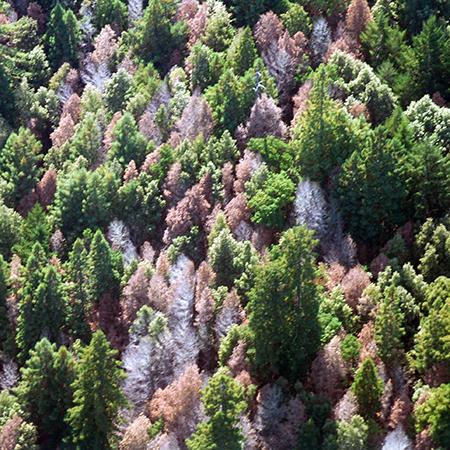
Sudden Oak Death (SOD), caused by the introduced pathogen Phytophthora ramorum, was first documented in the United States on Marin Water and California State Parks lands in Marin County in 1995 (Garbelotto & Rizzo, 2005). It has killed tens of thousands of trees on Mt. Tam. Vegetation mapping in 2004, 2009, and 2014 (AIS, 2015) tracked the rapid spread of the disease across Marin Water lands. The 2014 update found that 84% of forested vegetation types were affected, although the degree of impact varied by forest species and by woodland canopy characteristics (AIS, 2015).
The SOD mortality rate exceeds 80% for tanoak (Notholithocarpus densiflorus), the loss of which has transformed thousands of acres where this species was once dominant in the canopy. Mapping done in 2018 as part of the Marin Regional Forest Health Strategy shows 98% of the remaining 36 acres of tanoak-dominated forest with significant canopy mortality (GGNPC, 2023a). Mortality rates are lower but still significant among the coast live oak (Quercus agrifolia) andCalifornia black oak (Q. kelloggii). Dozens of other native tree and shrub species also experience damage and/or lower levels of mortality. The white oak, including valley oak (Q. lobata) and Oregon oak (Q. garryana), are not affected (APHIS, 2022).
In addition to causing dramatic changes in habitat structure, dying and dead trees increase fuel loads. The effects of the loss of oak trees on species dependent on them for food and shelter (e.g., dusky-footed woodrat [Neotoma fuscipes], Acorn Woodpecker [Melanerpes formicivorus]) are not yet known (Cunniffe et al., 2016). Oaks and other hardwood species affected by SOD are an important and culturally significant forest type for the Coast Miwok people, providing food, medicine, and other cultural materials. Reducing barriers to Indigenous stewardship practices in Marin County could have restorative effects for hardwood forests and woodlands (Nelson, 2023).
Other Plant Pathogens
Several other disease-causing forest pathogens withe the same ecosystem effects as SOD have either been observed on the mountain or have a high likelihood of invading in the near future. In particular, cinnamon fungus (Phytophthora cinnamomi) is deadly to Pacific madrone (Arbutus menziesii) and some species of manzanita. This pathogen is known to occur in Marin County, including several locations on Mt. Tam (T. Swiecki, personal communication). According to the Marin Regional Forest Health Strategy, 26% (280 acres) of madrone forest on Mt. Tam is experiencing moderate canopy mortality, which could be linked to impacts from Phytophthora species (GGNPC, 2023a). Although P. cinnamomi spreads more slowly than P. ramorum, it has a much broader range of host species and the potential to kill a wider variety of species (Sims et al., 2016).
resources
Aerial Information Systems, Inc. (2015). Summary Report for the 2014 Photo Interpretation and Floristic Reclassification of Mt. Tamalpais Watershed Forest and Woodlands Project, prepared by Aerial Information Systems, Inc. for the Marin Municipal Water District.
Animal and Plant Health Inspection Service [APHIS]. (2022). List of regulated hosts and plants proven or associated with Phytophthora ramorum. U.S. Department of Agriculture. https://tinyurl.com/bde9v2js
Cunniffe, N. J., Cobb, R. C., Meentemeyer, R. K., Rizzo, D. M., & Gilligan, C. A. (2016). Modeling when, where, and how to manage a forest epidemic, motivated by sudden oak death in California. Proceedings of the National Academy of Sciences USA (20), 5640–5645. https://doi.org/10.1073/pnas.1602153113
Garbelotto, M. & Rizzo, D. (2005). A California-based chronological review (1995 -2004) of research on Phytophthora ramorum, the causal agent of sudden oak death. Phytopathologia Mediterranea, 44 (2), 1-17.
Golden Gate National Parks Conservancy [GGNPCa]. (2023). Marin regional forest health strategy.Tamalpais Lands Collaborative (One Tam).https://www.onetam.org/forest-health
Nelson, P. A. and Golden Gate National Parks Conservancy [GGNPC] (2023). Chapter 3: Tribal Stewardship & Partnership. In Marin Regional Forest Health Strategy (pp. 63-90). Tamalpais Lands Collaborative (One Tam). https://www.onetam.org/forest-health
Sims, L., Conforti, C., Gordon, T., Larssen, N., & Steinharter, M. (2016). Presidio phytophthora management recommendations [Unpublished report].