Peak Health home > Landscapes > Biodiversity
Overall biodiversity on Mt. Tam is in Fair condition, with an unknown trend. Our confidence is moderate. This combined metric of all Peak Health indicators is considered the overall health of Mt. Tam in our assessment.
Extrapolating from the area of focus and assessed by looking at a collection of the key taxonomic groups shown below (Figure 26.2 in the report), the condition of Mt. Tam’s overall health is judged to be caution, with an unknown trend. This evaluation reflects the challenge of identifying trends over time when new elements—the addition of indicators (bats, bees, and California giant salamander), the removal of an indicator (American badger), and the use of new classifications and techniques in the 2018 Fine Scale Vegetation Map—have been introduced. Each group has one equal segment, and each segment was given its own condition and confidence score by averaging those of the indicators within them (Figure 26.2). For example, the mammal grouping included native mammal diversity, bats, and North American river otter. Future work to refine this overall biodiversity assessment could include other important taxonomic groups currently lacking data (e.g., fungi, lichens, and invertebrates).
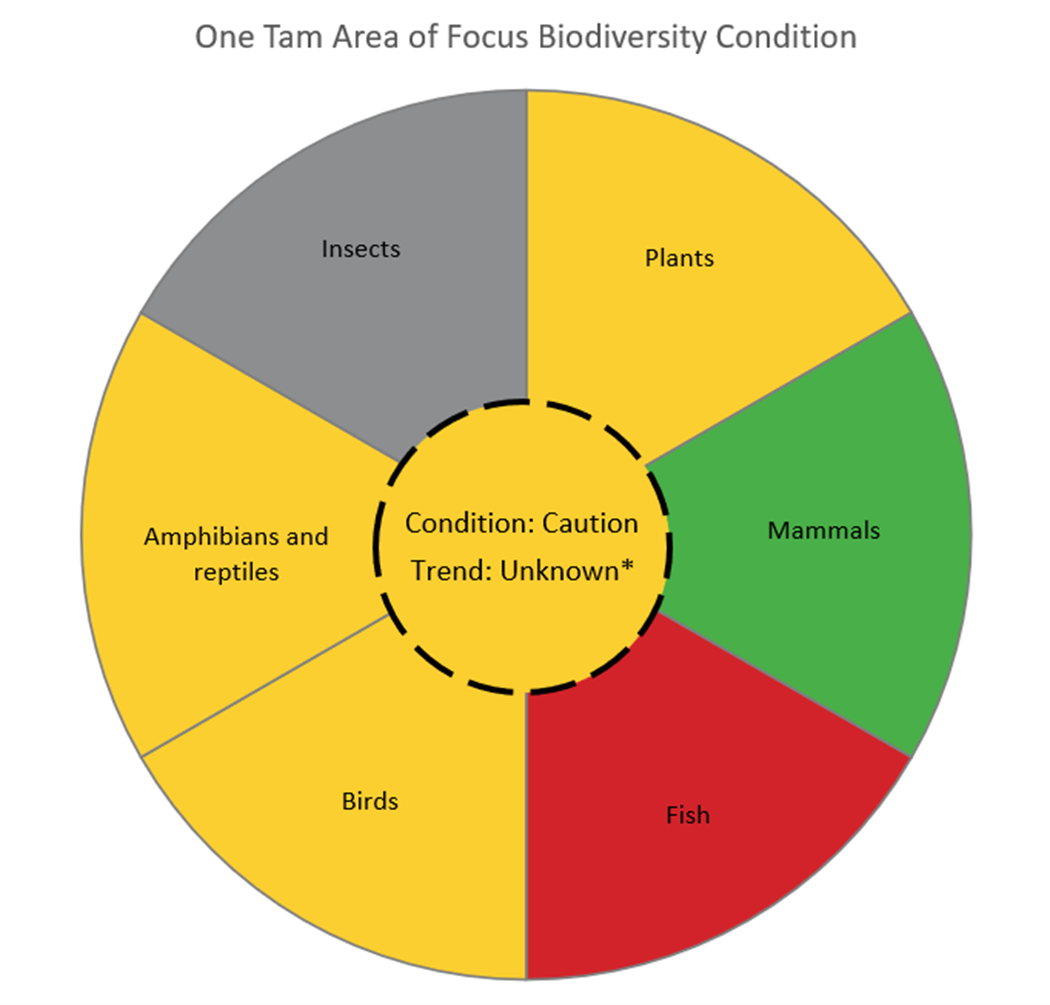
Some taxonomic groups included in this figure have experienced local or global extirpations and include species that are in perilous condition, while others with limited extinctions and generally healthy populations are faring better. In most cases, a much more complex reality underlies each segment of this figure. For example, there are more than 750 known native plant species and in excess of 300 known non-native species. While some non-native species have limited distribution and impact, many are noxious invasives that affect native species and processes by out-competing and displacing native species, altering habitats and fire regimes, and requiring significant resources to control and eradicate (Mack & D’Antonio, 1998; Hobbs & Mooney, 2005; Pimentel et al., 2005). In addition, 65 likely plant extirpations have been documented (Appendix 4). Of the known extant native plant species, more than 40 are considered rare, threatened, or endangered. These special-status plants are susceptible to stochastic events and existing stressors that could lead to further imperilment, and even local or global extinction.
Despite losses and threats from non-native species and other pressures, the floristic biodiversity of the area is high and supports an equally high diversity of habitats that host dozens of wildlife species. These vegetation and habitat types are defined by high variability in topography, temperature, precipitation, and soils within the One Tam area of focus.
We did not establish a trend in the overall condition for Mt. Tam between 2016 and 2022 because of the addition of new indicators since 2016, an expanded geography, and a major new vegetation mapping effort that parses those communities differently than before. In addition, some indicators improved while others declined or did not see a change in condition.