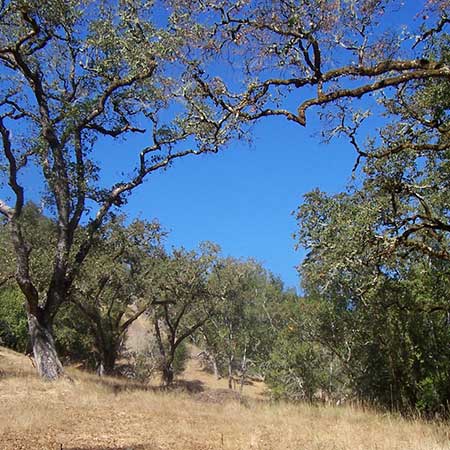
Peak Health home > Landscapes > Ecosystems > Open-canopy Oak Woodland Communities
Summary
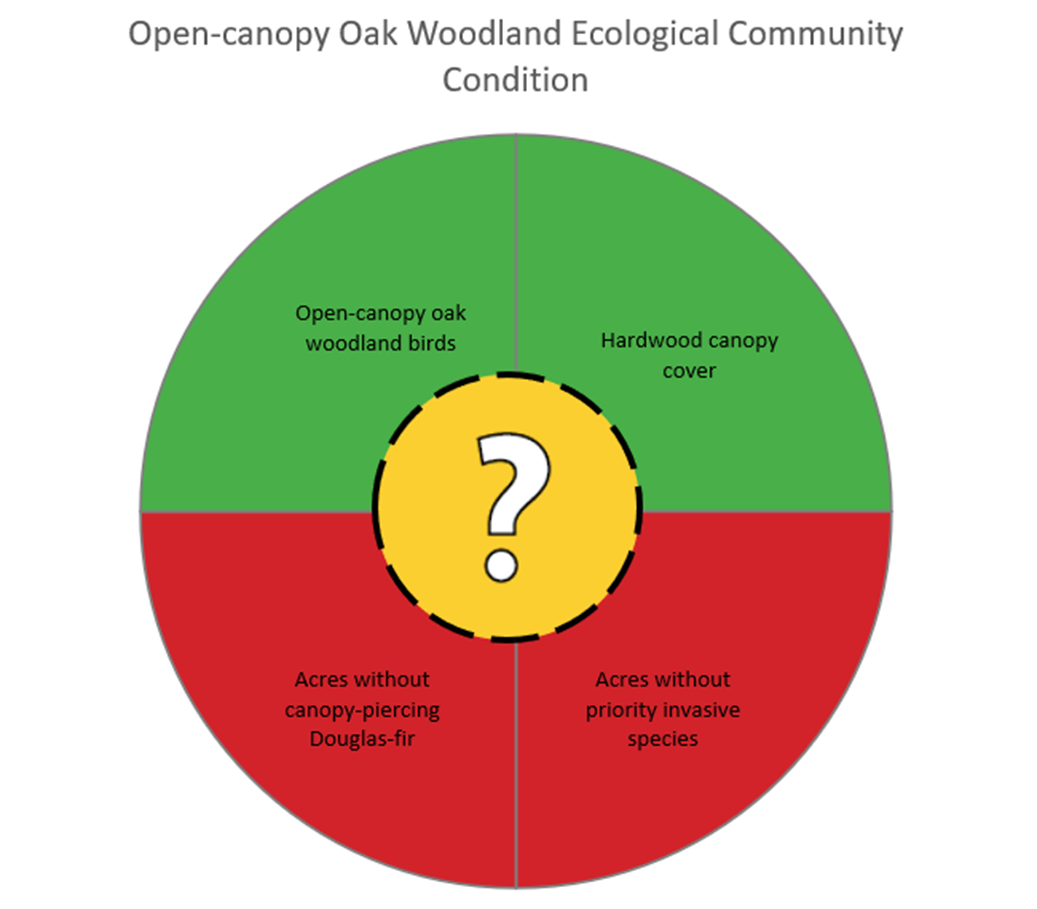
Open-canopy oak woodlands are in a condition of Caution, mostly due to invasive species, Sudden Oak Death, and Douglas-fir encroachment.
Invasive Species & Disease
Douglas-fir recruitment, which is slowly leading to mixed-conifer hardwood woodlands, is likely driven by fire suppression. Furthermore, several species of broom continue to rapidly invade and colonize many of Mt. Tam’s oak woodlands. This has also likely led to a reduction in the diversity and abundance of birds and mammals (Freed & McAllister, 2008). SOD continues to be the major stressor in this community. A 2014 Marin Water survey found that more than 90% of open-canopy oak woodlands were affected by the pathogen (AIS, 2015). This disease, which is expected to continue to kill oaks, may eventually transform these oak woodlands into woodlands or forests with very minor oak components.
Animals
Oak woodlands are known centers of high avian diversity (Zack et al., 2002). The condition of the oak woodland bird guild stayed in the good range, and the trend went from no change to improving. This may be in part because the number of species included increased, with a few species assigned to this habitat in 2022 that were either not previously included or were included but for which we lacked adequate data to analyze a trend.
Climate Change
The future of oak woodlands under potential climate change scenarios is uncertain (Ackerly et al., 2012; Ackerly et al., 2015; Cornwell et al., 2012). However, a warmer future is likely to increase both the prevalence of SOD and its effects on coast live oak and black oak types.
resources
Ackerly, D. D., Ryals, R. A., Cornwell, W. K, Loarie, S. R., Veloz, S., Higgason, K. D, Silver, W. L., & Dawson, T. E. (2012). Potential impacts of climate change on biodiversity and ecosystem services in the San Francisco Bay Area (Publication number CEC-500-2012-037). California Energy Commission. https://cawaterlibrary.net/wp-content/uploads/2017/06/CEC-500-2012-037.pdf
Ackerly, D. D., Cornwell, W. K, Weiss, S. B., Flint, L. E., & Flint, A. L. (2015). A geographic mosaic of climate change impacts on terrestrial vegetation: Which areas are most at risk? PLoS ONE, 10(6), e0130629. http://dx.doi.org/10.1371/journal.pone.0130629
Aerial Information Systems [AIS]. (2015). Summary report for the 2014 photo interpretation and floristic reclassification of Mt. Tamalpais Watershed forest and woodlands project. Prepared for Marin Municipal Water District. https://tukmangeospatial.egnyte.com/dl/3UV0A0o3HS
Cornwell, W. K., Stuart, S., Ramirez, A., Dolanc, C. R., Thorne, J. H., & Ackerly, D. D. (2012). Climate change impacts on California vegetation: Physiology, life history, and ecosystem change (White Paper from California Energy Commission’s California Climate Change Center). Publication number: CEC-500-2012-023. Berkeley, CA: University of California, Berkeley. Available from: http://www.energy.ca.gov/2012publications/CEC-500-2012-023/CEC-500-2012-023.pdf.
Freed, S., & McAllister, K. (2008). Occurrence and distribution of mammals on the McChord Air Force Base, Washington. Environmental Practice, 10(3), 116–124. https://doi.org/10.1017/S146604660808023X
Zack, S., Chase, M. K., Geupel, G. R., & Stralberg, D. (2002). The oak woodland bird conservation plan: A strategy for protecting and managing oak woodland habitats and associated birds in California (v. 2.0). Point Reyes Bird Observatory/California Partners in Flight. https://tinyurl.com/yxfkna3s