Peak Health home > Wildlife > Birds > Osprey
Why Was This Indicator Chosen?
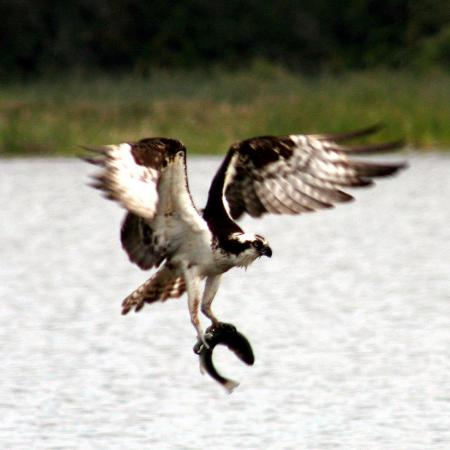
Because they feed almost exclusively on fish, the breeding success of Ospreys (Pandion haliaetus) in the lakes and reservoirs in the One Tam area of focus is a good indicator of water quality and fish abundance. The Kent Lake Osprey colony was first established in the mid-1960s and has been monitored continuously by the Marin Municipal Water District since 1981.
Persecution and environmental contamination in the 19th and early 20th centuries led Osprey to be listed as a California Species of Special Concern. The Kent Lake Osprey colony peaked in the mid-1990s, then entered a period of gradual decline over the subsequent two decades. Recent monitoring suggests the colony is currently about half of its former size.
What is Healthy?
A healthy nesting population of Osprey on Mt. Tam would remain stable over time. High levels of pair occupancy and annual reproductive success would be maintained within the normal range of variability, or above long-term average values based on recent historical monitoring.
What Are the Biggest Threats?
- Climate change and drought may negatively impact Osprey fishing and reproductive fledgling success
- Contaminants such as mercury and residual DDT in nearby areas where Osprey are known to forage
- Competition from Bald Eagles (which recolonized Kent Lake in 2008) and nest site depredation by other local predators
What is The Current Condition?
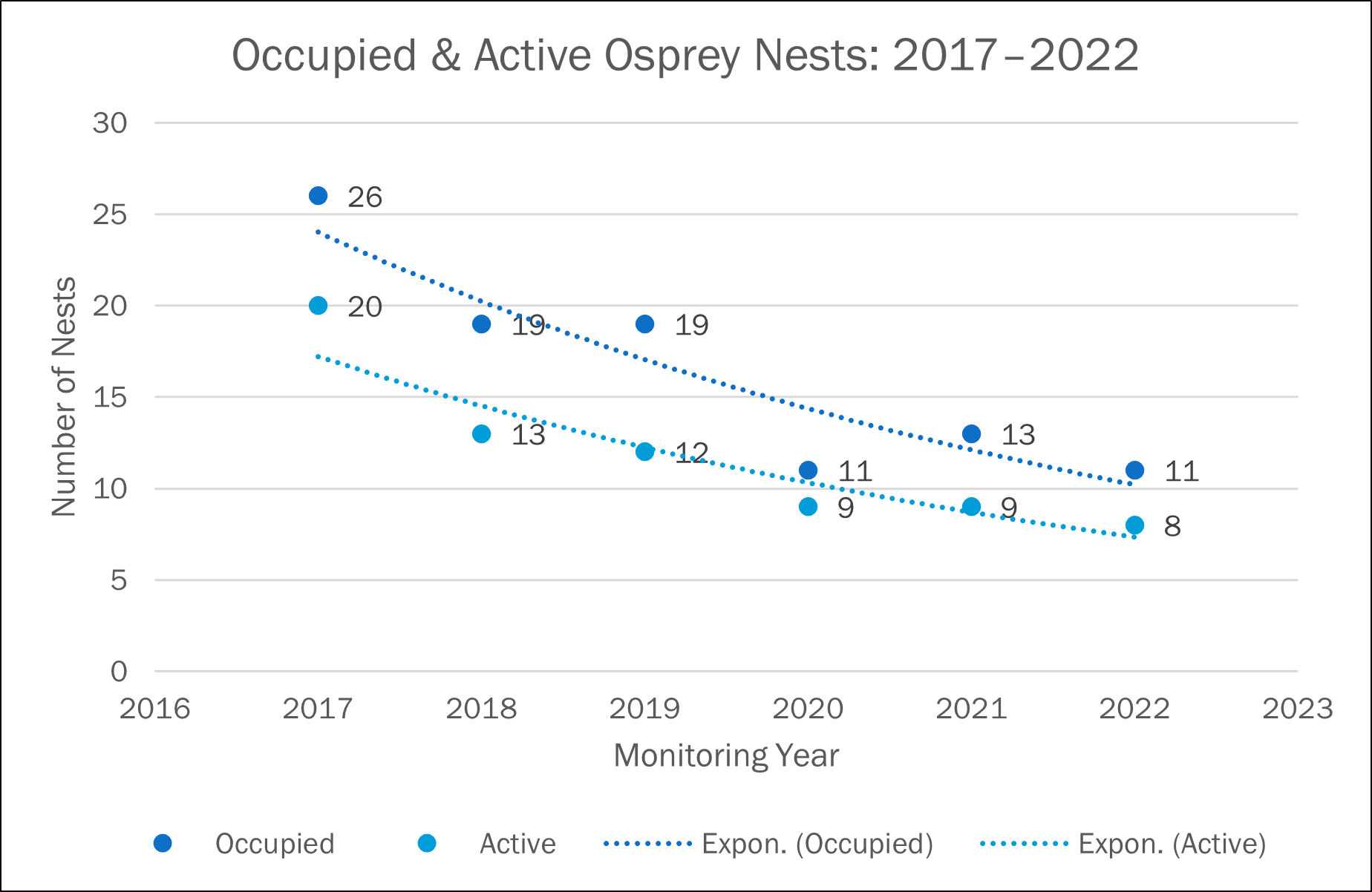
The overall condition of Kent Lake’s Osprey colony is Poor. This is primarily as a result of a decrease in reproductive effort, which went from good in the 2016 assessment to significant concern in 2022 because of a precipitous decline in the number of occupied and active nests between 2017 to 2022. We are not certain what caused this decline but expect that it is due to a number of reasons (including competition with Bald Eagles) rather than a single cause.
How Sure Are We?
Overall confidence in these assessments is Moderate because we have consistent nest survey data since 1981 and current tree counts. However, systematic monitoring of reproductive success has not been conducted since 2000.
What is This Assessment Based On?
Monitoring and assessments of the number of occupied nests, nest site occupancy rate (the number of active nests as a percent of occupied nests), number of nestlings fledged from active nests, and the number of dead trees that provide nesting habitat (Evens, 2015).
What Don’t We Know?
Key information gaps include:
- Annual observations to determine reproductive productivity
- Foraging patterns and locations, prey availability, and local ecological dynamics of prey species (e.g., top smelt)
- The presence of mercury and other contaminants in the birds
resources
Ackerman, J. T., Eagles-Smith, C. A., Heinz, G., De La Cruz, S. E., Takekawa, J. Y., Miles, A. K., Adelsbach, T. L., Herzog, M. P., Bluso-Demers, J. D., Demers, S. A., Herring, G., Hoffman, D. J., Hartman, C. A., Willacker, J. J., Suchanek, T. H., Schwarzbach, S. E., & Maurer, T. C. (2014). Mercury in birds of San Francisco Bay-Delta, California: Trophic pathways, bioaccumulation, and eco-toxicological risk to avian reproduction (USGS Open-File Report 2014-1251). US Geological Survey. http://dx.doi.org/10.3133/ofr20141251
Avocet Research Associates [ARA]. (2022). Osprey (Pandion haliaetus): The 2022 nesting season, Kent Lake reservoir, Marin Municipal Water District, Marin County, California (Final annual report). Prepared for Marin Municipal Water District.
Brake, A. J. (2021). An expanding osprey nesting population on San Francisco Bay [PowerPoint slides]. Golden Gate Raptor Observatory.
Buzby, N., Davis, J., Sutton, R., Yee, D., Miller, E., Wong, A., Sigala, M., Bonnema, A., Heim, W., Grace, R. (2021). Contaminant concentrations in sport fish from San Francisco Bay: 2019 (SFEI Contribution No. 1036). San Francisco Estuary Institute. https://www.sfei.org/documents/contaminant-concentrations-sport-fish-san-francisco-bay-2019
Evens, J. G. (2001). Ospreys at Kent Lake, Marin County, California: The 2000 breeding season (Final report). Prepared for Marin Municipal Water District.
———. (2015). Osprey (Pandion haliaetus): The 2015 nesting season at Kent Lake, Marin County, California (Annual report). Prepared for Marin Municipal Water District.
———. (2022). Adult female osprey killed by bobcat on nest site in Inverness, California. Northwestern Naturalist, 103(3), 257–258. https://doi.org/10.1898/1051-1733-103.3.257
Evens, J. G., & Brake, A. J. (2022). Osprey shift from nesting in natural trees to artificial structures in the San Francisco Bay Area, California. Northwestern Naturalist, 103(3), 259–267. https://doi.org/10.1898/1051-1733-103.3.259
Grove, R. A., Henny, C. J., & Kaiser, J. L. (2009). Osprey: Worldwide sentinel species for assessing and monitoring environmental contamination in rivers, reservoirs, and estuaries. Journal of Toxicology and Environmental Health, 12(1), 25–44. https://doi.org/10.1080/10937400802545078
Henny, C. J., & Wight, H. W. (1969). An endangered osprey population: Estimates of mortality and production. The Auk, 86(2), 188-198. https://doi.org/10.2307/4083495
Poole, A. F. (1989). Ospreys: A natural and unnatural history. Cambridge University Press.
Spitzer, P. & Poole, A. (1980). Coastal ospreys between New York City and Boston: A decade of reproductive recovery, 1969-1979. American Birds, 34(3), 234–241. https://sora.unm.edu/sites/default/files/journals/nab/v034n03/p00234-p00241.pdf
U.S. Environmental Protection Agency [U.S. EPA]. (2015). Draft focused feasibility study: United Heckathorn Superfund Site. U.S. Environmental Protection Agency.