Peak Health home > Wildlife > Fish > Coho Salmon in Redwood Creek
What is Healthy?
The desired conditions for Redwood Creek coho salmon populations are described in numerical targets for each life stage, as well as the critical habitat conditions that support those life stages. The National Marine Fisheries Service (NMFS) recovery plan for this species (2012) lists specific goals for the number of adult spawners and redds (nests), juveniles, and smolts (young fish migrating out to sea).
What Are the Biggest Threats?
- Historic hydrological changes and habitat loss that have affected anadromous fish migration, increased sedimentation, and reduced the number of pools and other critical habitats
- Current hydrological changes and habitat loss including water withdrawals, drought, channel incision, and a loss of downstream floodplain connectivity
- Ocean-related factors such as over-harvesting of salmonids as well as their prey (e.g., sardines) and changes to ocean food webs related to climate change
- Potential invasive aquatic species including exotic mollusks such as New Zealand mud snail (Potamopyrgus antipodarum) and the spread of invasive Japanese knotweed (Fallopia japonica)
- The effects of climate change such as higher water temperatures, longer droughts, more intense rainfall, and disruptions in the ocean food web
What is The Current Condition?
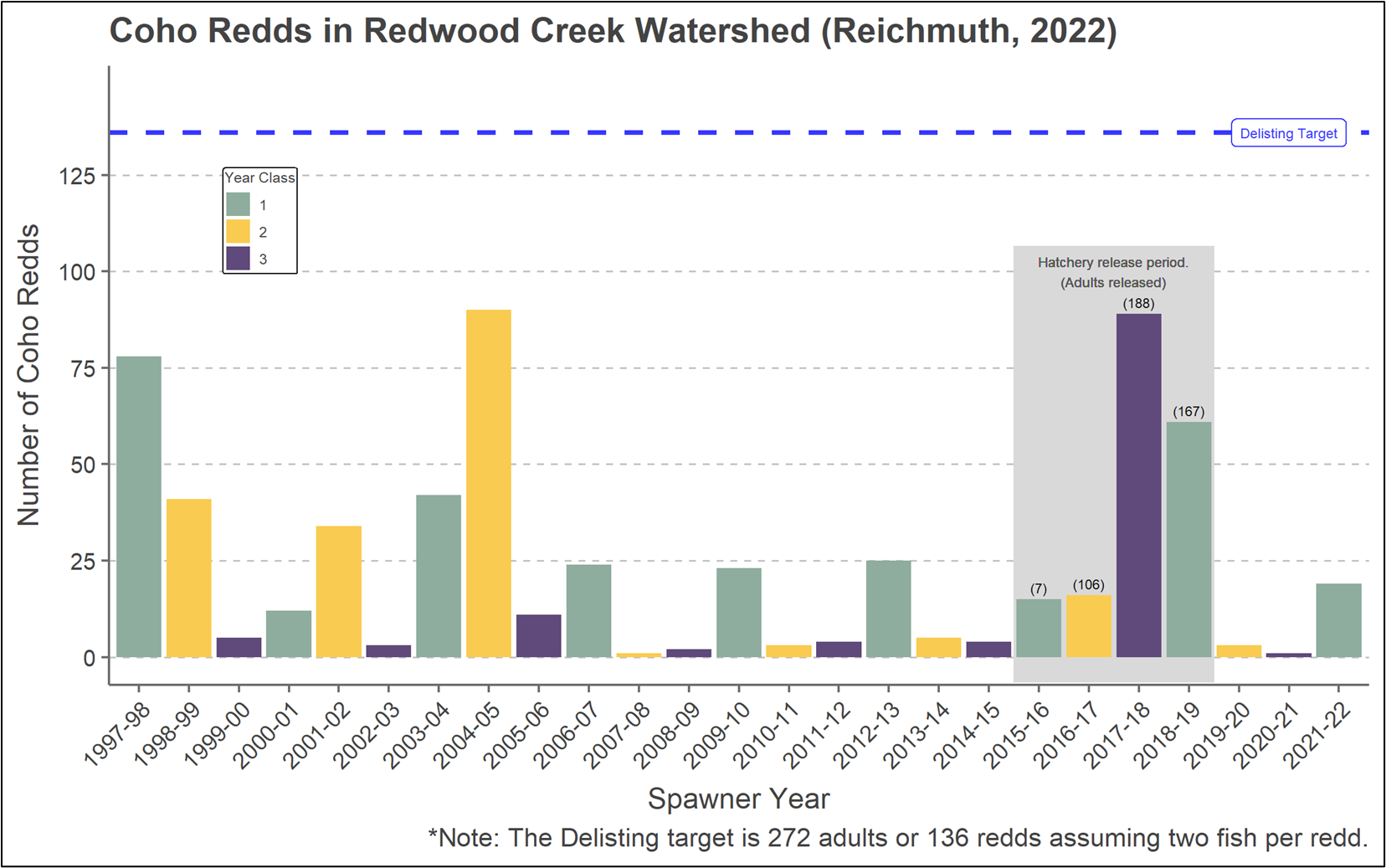
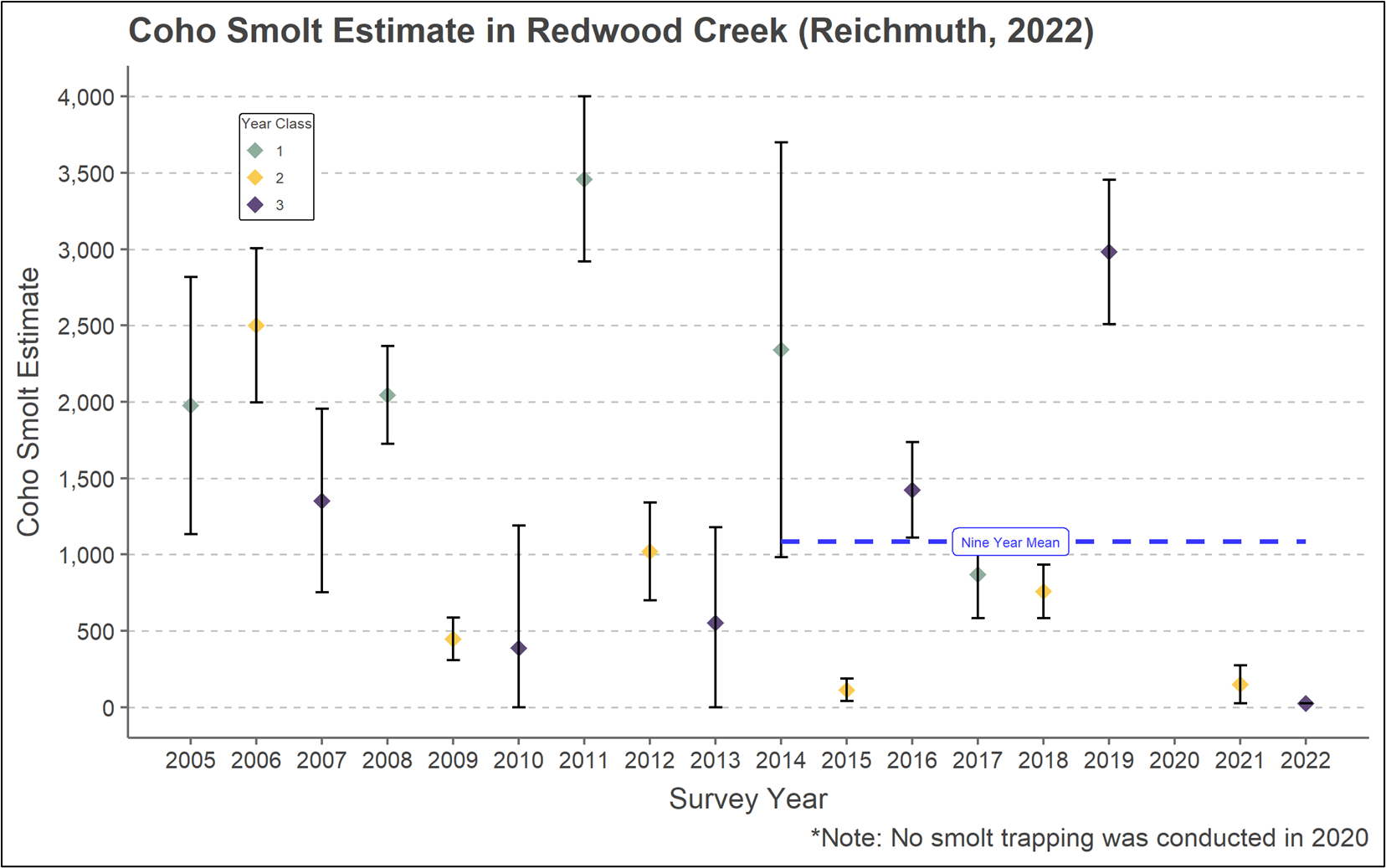
The overall condition of Redwood Creek’s coho salmon is Poor. Numbers of adults and redds are only at approximately 12 percent of the NMFS recovery goal, and smolts are at about 9%. In Redwood Creek, coho salmon have not increased and, despite active efforts to jumpstart their numbers using hatchery-rearing techniques, the number of adults for two of the three-year classes has decreased since 2016.
What is the Current Trend?
Overall, this species is Declining. Over the last nine years (three generations) two of three year classes have remained at dangerously low levels in Redwood Creek, while the third year class recently declined. Wood loading is improving however, and the numbers of pools per mile have not changed.
How Sure Are We?
We have Moderate confidence in this assessment based on the amount and quality of data we have on coho life stages, but there is some uncertainty around juvenile and smolt estimates.
What is This Assessment Based On?
- NMFS Federal Register documents (NMFS 2012, 2015)
- National Park Service inventory and annual monitoring (Carlisle et al., 2016)
- Redwood Creek Watershed Assessment (Stillwater Sciences, 2011)
What Don’t We Know?
Key information gaps include:
- The timing and magnitude of salmonid migration between streams using Passive Integrated Transponder (PIT) tag technology would provide valuable information on habitat needs during multiple life stages
- Further definition for the metric of pool habitat availability is needed
resources
Bay Area Open Space Council [BAOSC]. (2019). The conservation lands network 2.0 [Report]. https://www.bayarealands.org/maps-data/
California Department of Fish and Wildlife [CDFW]. (2016). Redwood Creek coho salmon rescue and captive rearing project. https://www.wildlife.ca.gov/Drought/Projects/Redwood-Creek-Coho
California Regional Water Quality Control Board, San Francisco Bay Region [CRWQCB]. (2014). Lagunitas Creek watershed sediment TMDL. https://tinyurl.com/yvy9fyrm
Carlisle, S., & Reichmuth, M. (2015). Long-term monitoring of coho salmon and steelhead trout during freshwater life stages in coastal Marin County: 2013 annual report (Natural Resource Report, NPS/SFAN/NRR—2015/956). National Park Service. https://irma.nps.gov/DataStore/Reference/Profile/2221853
Carlisle, S., Reichmuth, M., & McNeill. B. (2016). Long-term monitoring of coho salmon and steelhead trout during freshwater life stages in coastal Marin County: 2014 annual report (Natural Resource Report. NPS/SFAN/NRR—2016/1142). National Park Service. https://irma.nps.gov/DataStore/DownloadFile/546839
Ettlinger, E. (2017). Lagunitas Creek salmonid habitat: 2016. Marin Water.
Ettlinger, E., Andrew, G., Doughty, P., & Rogers, V. (2015a). Adult salmonid monitoring in the Lagunitas Creek watershed: 2014–2015. Marin Water.
Ettlinger, E., Doughty, P., Rogers, V., & Andrew, G. (2015b). Smolt monitoring in the Lagunitas Creek watershed: 2015. Marin Water.
Ettlinger, E., Howe, J., & Sherman, J. (2021). Adult salmonid monitoring in the Lagunitas Creek watershed: 2020–2021. Marin Water. https://tinyurl.com/5bed2zpw
Ettlinger, E. Koehler, J., Cox, E., & Joe, K. (2023). Smolt monitoring in the Lagunitas Creek watershed: 2022. Marin Water. https://tinyurl.com/4vj9wu5x
Ettlinger, E., Ruiz, E., Hossfeld, D., & Andrew, G. (2016). Juvenile salmonid monitoring in the Lagunitas Creek watershed: 2015. Marin Water.
Ettlinger, E., Schleifer, B., & Andrew, G. (2013). Lagunitas Creek salmonid habitat: 2011. Marin Water.
Kar, S., Sangem, P., Anusha, N., & Senthilkumaran, B. (2020). Endocrine disruptors in teleosts: Evaluating environmental risks and biomarkers. Aquaculture and Fisheries, 6(1), 1–26. https://doi.org/10.1016/j.aaf.2020.07.013
Marin Water. (2011). Lagunitas Creek stewardship plan. https://tinyurl.com/56asd75h
Marlatt, V. L., Leung, T. Y. G., Calbick, S., Metcalfe, C., & Kennedy, C. (2019). Sub-lethal effects of a neonicotinoid, clothianidin, on wild early life stage sockeye salmon (Oncorhynchus nerka). Aquatic Toxicology, 217, 105335. https://doi.org/10.1016/j.aquatox.2019.105335
Moyle, P. B., Israel, J. A., & Purdy, S. E. (2008). Salmon, steelhead, and trout in California: Status of an emblematic fauna. Prepared for California Trout. https://tinyurl.com/y6dpx7f9
National Marine Fisheries Service [NMFS]. (2012). Recovery plan for the evolutionarily significant unit of central California coast coho salmon (Vol. 1). https://repository.library.noaa.gov/view/noaa/15987
National Marine Fisheries Service [NMFS]. (2015). Recovery plan for north central California coast recovery domain: California coastal chinook salmon, northern California steelhead, central California coast steelhead (Draft).
Pierce, D. W., Kalansky, J. F., & Cayan, D. R. (2018). Climate, drought, and sea level rise scenarios for California’s fourth climate change assessment (Publication no. CCCA4-CEC-2018-006). Prepared for California Energy Commission. https://tinyurl.com/4hu6r6uh
Quinn, T. P. (2005). The behavior and ecology of Pacific salmon and trout. University of Washington Press.
Ross Taylor & Associates. (2003). Marin County stream crossing inventory and fish passage evaluation. Prepared for the County of Marin, Department of Public Works. https://tinyurl.com/9utcfefe
Schindler, D. E., Hilborn, R., Chasco, B., Boatright, C. P., Quinn, T. P., Rogers, L. A., & Webster, M. S. (2010). Population diversity and the portfolio effect in an exploited species. Nature, 465, 609–612. https://doi.org/10.1038/nature09060
Stillwater Sciences. (2008). Lagunitas limiting factors analysis; Limiting factors for coho salmon and steelhead (Final report). Prepared for Marin Resource Conservation District. https://calisphere.org/item/ark:/86086/n2154g1r/
Stillwater Sciences. (2011). Redwood Creek watershed assessment (Final report). Prepared for Golden Gate National Recreation Area. https://www.nps.gov/goga/learn/management/upload/RCWA_FINAL.pdf
Tian, Z., Zhao, H., Peter, K. T., Gonzalez, M., Wetzel, J., Wu, C., Hu, X., Prat, J., Mudrock, E., Hettinger, R., Cortina, A. E., Biswas, R. G., Kock, F. V. C., Soong, R., Jenne, A., Du, B., Hou, F., He, H., Lundeen, R., … Kolodziej, E. P. (2020). A ubiquitous tire rubber–derived chemical induces acute mortality in coho salmon. Science, 371(6525), 185–189. 10.1126/science.abd6951
Torregrosa, A., Flint, L. E., & Flint, A. L. (2020). Hydrological resilience for summertime fog and recharge: A case study for coho salmon recovery planning. Journal of the American Water Resources Association, 56(1), 134–160. https://doi.org/10.1111/1752-1688.12811
Urgenson, L. S. (2006). The ecological consequences of knotweed invasion into riparian forests [Unpublished master’s thesis]. University of Washington. https://tinyurl.com/2zfb6k2h
Vinson, M. R., & Baker, M. A. (2008). Poor growth of rainbow trout fed New Zealand mud snails Potamopyrgus antipodarum. North American Journal of Fisheries Management, 28(3), 701–709. https://doi.org/10.1577/M06-039.1