Peak Health home > Wildlife > Reptiles & Amphibians > Foothill Yellow-legged Frog
Why Was This Indicator Chosen?
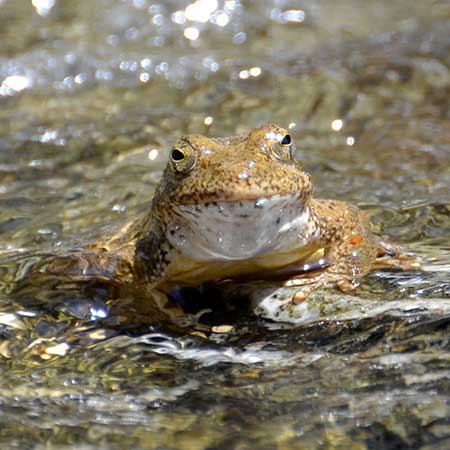
Foothill yellow-legged frogs (Rana boylii) are good indicators of the perennial and ephemeral streams they rely on for breeding and post-metamorphic habitat. Early life stages are sensitive to changes in flow and water temperature, and are vulnerable to both recreational use and aquatic invasive species.
Widespread population declines have led to their listing as a Federal Species of Concern, a U.S. Forest Service Sensitive Species, and a California Species of Special Concern. Foothill yellow-legged frog range and numbers have declined dramatically in Marin County and in the One Tam area of focus over the last 75 years, and they are now only found in Big and Little Carson Creeks. Marin Municipal Water District breeding surveys from 2004 and 2016 indicate the remaining breeding populations have been relatively stable (GANDA, 2016), but they are highly vulnerable due to their small size and isolation from other populations.
Learn more about these special frogs and how you can help them.
What is Healthy?
A healthy population of foothill yellow-legged frogs would have all life stages in currently occupied streams with stable or increasing numbers of egg masses and adults detected each year. Furthermore, breeding populations would be reestablished in historically occupied streams including Cataract and Redwood creeks. Breeding habitat quality would be improved, and the impacts of humans and non-native predators minimized.
What Are the Biggest Threats?
- Predation by invasive bullfrogs (R. catesbiana) and signal crayfish (Pacifastacus leniusculus), as well as native rough-skinned newts (Taricha granulosa)
- In-stream habitat disturbance that affects the cobble and gravel where foothill yellow-legged frogs lay their eggs
- Chytrid fungus (Batrachochytrium dendrobatidis), which has caused amphibian population declines worldwide, although it does not seem to be affecting foothill yellow-legged frogs on Mt. Tam
- Potential inbreeding as a result of living in small, isolated populations
- Water temperature and flow fluctuations, both of which may occur under future climate change scenarios
What is The Current Condition?
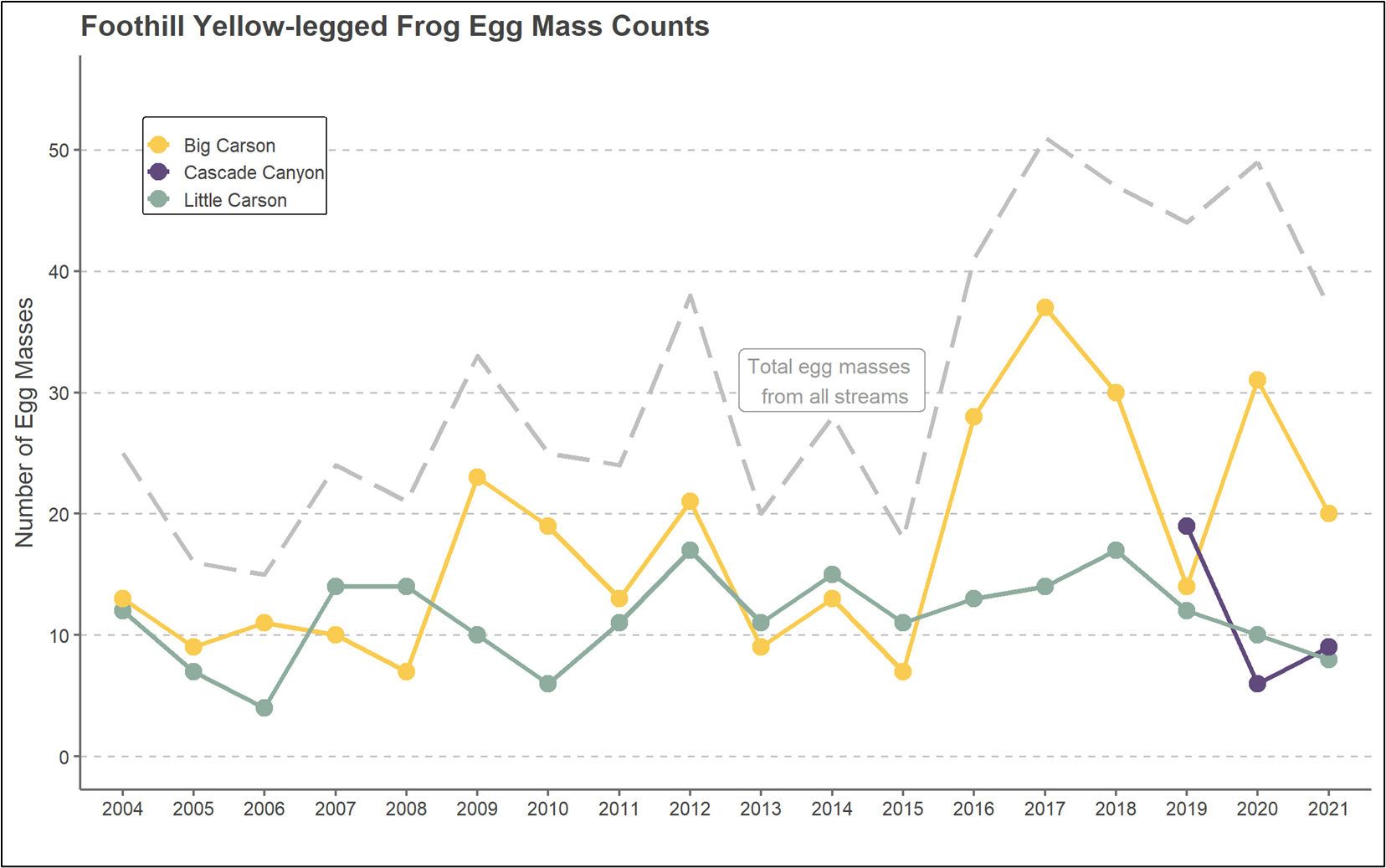
The current condition is Fair. Over the last five years (2017-2022), an average of 39 foothill yellow-legged frog egg masses were documented in Little Carson and Big Carson Creeks—far more than the 24 egg masses required to qualify this metric as being in good condition. In addition, an average of 11 egg masses per year were documented in the Cascade Canyon Preserve over the last three years (2019-2022).
Small populations of the foothill yellow-legged frog in the One Tam area of focus are still at risk of extirpation but are less vulnerable than they were when the original 2016 Peak Health Report was written. The factors most responsible for improvement are:
- The discovery of a new population in Cascade Canyon Preserve near Fairfax. While this population is not within the One Tam area of focus, it likely has strong connections to the populations at Little Carson and Big Carson Creeks and strengthens the viability of those populations. Surveyors have observed egg masses in Cascade Creek every year since 2018 (Kleinfelder, 2022).
- Two subadults observed in Devil’s Gulch Watershed (Golden Gate National Recreation Area) in Spring 2020.
- More egg masses found in Big Carson Creek, possibly as a result of management actions to enhance breeding habitat, relocate egg masses away from a road crossing, and remove non-native predators.
- A high rate of successful egg hatching and no observed human-caused egg mass destruction in recent years.
What is the Current Trend?
A trend of Improving is based on annual survey results since 2004 that show that even though the populations are at great risk because they are small and isolated, sightings of more frogs in more places signifies an improvement in the condition and trend of this indicator of ecosystem health, with a high degree of confidence.
How Sure Are We?
Confidence in this assessment is High because surveys have been conducted by trained biologists using consistent techniques since 2004. However, while there are no other populations known in the One Tam area of focus, we have not conducted a full survey of suitable habitats since 2003.
What is This Assessment Based On?
- A habitat survey in 2003 (GANDA, 2003)
- Egg mass surveys since 2004, which also document other life stages (egg masses, tadpoles, juveniles, and adults) (GANDA, 2013)
- National Park Service and California State Parks Detection Surveys, Muir Woods, 2013
What Don’t We Know?
Key information gaps include:
- Population viability analysis based on existing time-series data from Big Carson Creek, its tributaries, and Little Carson Creek
- The potential range for individual frogs (although chin pattern analysis combined with mark and recapture studies suggest there is very little movement between frogs at Big Carson and Little Carson creeks) (Marlow, 2016)
- Habitat requirements for life stages other than eggs and tadpoles, or for movement from one breeding site to another
resources
California Fish and Game Commission [CFGC]. (2020). Notice of findings for foothill yellow-legged frog (Rana boylii).
Center for Biological Diversity [CBD]. (2021). Foothill yellow-legged frog. Accessed December 14, 2021, at http://www.biologicaldiversity.org/species/amphibians/foothill_yellow-legged_frog
Federal Register. (2021). Endangered and threatened wildlife and plants; Foothill yellow-legged frog; Threatened status with section 4(d) rule for two distinct population segments and endangered status for two distinct population segments (FR doc no. 2021–27512). https://www.govinfo.gov/app/details/FR-2021-12-28/2021-27512
Fellers, G. M., & Freel, K. L. (1995). A standardized protocol for surveying aquatic amphibians. (Technical Report NPS/WRUC/NRTR 95-01). National Park Service. https://tinyurl.com/45twcnj7
Garcia and Associates [GANDA]. (2003). Foothill yellow-legged frog surveys and California red-legged frog protocol surveys. Prepared for Marin Municipal Water District.
Garcia and Associates [GANDA]. (2005). Foothill yellow-legged frog breeding success and monitoring at Little Carson Creek and Big Carson Creek, Mt. Tamalpais watershed, 2004. Prepared for Marin Municipal Water District.
Garcia and Associates [GANDA]. (2006). Foothill yellow-legged frog breeding success and monitoring at Little Carson Creek and Big Carson Creek, Mt. Tamalpais watershed, 2005. Prepared for Marin Municipal Water District.
Garcia and Associates [GANDA]. (2007). Foothill yellow-legged frog breeding success and monitoring at Little Carson Creek and Big Carson Creek, Mt. Tamalpais watershed, 2006. Prepared for Marin Municipal Water District.
Garcia and Associates [GANDA]. (2009). Foothill yellow-legged frog breeding success and monitoring at Little Carson Creek and Big Carson Creek, Mt. Tamalpais watershed, 2007 and 2008. Prepared for Marin Municipal Water District.
Garcia and Associates [GANDA]. (2010). Feasibility study for the reintroduction of the foothill yellow-legged frog (Rana boylii) within the Mt. Tamalpais watershed, Marin County, CA. Prepared for Marin Municipal Water District.
Garcia and Associates [GANDA]. (2011). Foothill yellow-legged frog breeding success and monitoring at Little Carson Creek and Big Carson Creek, Mt. Tamalpais watershed, 2009 and 2010. Prepared for Marin Municipal Water District
Garcia and Associates [GANDA]. (2013a). Foothill yellow-legged frog breeding success and monitoring at Little Carson Creek and Big Carson Creek, Mt. Tamalpais watershed, 2011 and 2012. Prepared for Marin Municipal Water District.
Garcia and Associates [GANDA]. (2013b). Foothill yellow-legged frog monitoring at Little Carson Creek and Big Carson Creek, Mt. Tamalpais watershed, 2012–2013. Prepared for Marin Municipal Water District.
Garcia and Associates [GANDA]. (2016). Foothill yellow-legged frog monitoring at Little Carson Creek and Big Carson Creek, Mt. Tamalpais watershed, 2014–2015. Prepared for Marin Municipal Water District.
Garcia and Associates [GANDA]. (2017). Foothill yellow-legged frog monitoring at Little Carson Creek and Big Carson Creek, Mt. Tamalpais watershed, 2016–2017. Prepared for Marin Municipal Water District.
Garcia and Associates [GANDA]. (2019). Summary of FYLF surveys for Little Carson Creek and Big Carson Creek and tributaries. Prepared for Marin Water District.
Gosner, K. L. (1960). A simplified table for staging anuran embryos and larvae with notes on identification. Herpetologica, 16, 183–190. https://www.jstor.org/stable/3890061
Kleeman, P. (2013). Foothill yellow-legged frog survey for the Bootjack trail project in Mount Tamalpais State Park, Marin County, CA. Western Ecological Research Center, USGS.
Kleinfelder. (2022). Foothill yellow-legged frog monitoring at Little Carson Creek and Big Carson Creek, Mt. Tamalpais watershed, 2021. Prepared for Marin Water District.
Marlow, K., Wiseman, K. D., Wheeler, C. A., Drennan, J. E., & Jackman, R. E. (2016). Identification of individual foothill yellow-legged frogs (Rana boylii) using chin pattern photographs: A non-invasive and effective method for small population studies. Herpetological Review, 47(2), 193–198. https://www.fs.usda.gov/research/treesearch/53442
Pierce, D. W., Kalansky, J. F., & Cayan, D. R. (2018). Climate, drought, and sea level rise scenarios for California’s fourth climate change assessment (Publication no. CCCA4-CEC-2018-006). Prepared for California Energy Commission. https://tinyurl.com/4hu6r6uh
Seltenrich, C. P., & Pool, A. C. (2002). A standardized approach for habitat assessments and visual encounter surveys for the foothill yellow-legged frog Rana boylii[Unpublished]. Pacific Gas and Electric Company, Technical and Ecological Services.