Peak Health home > Wildlife > Bees
Summary
The condition of bees is Unknown.
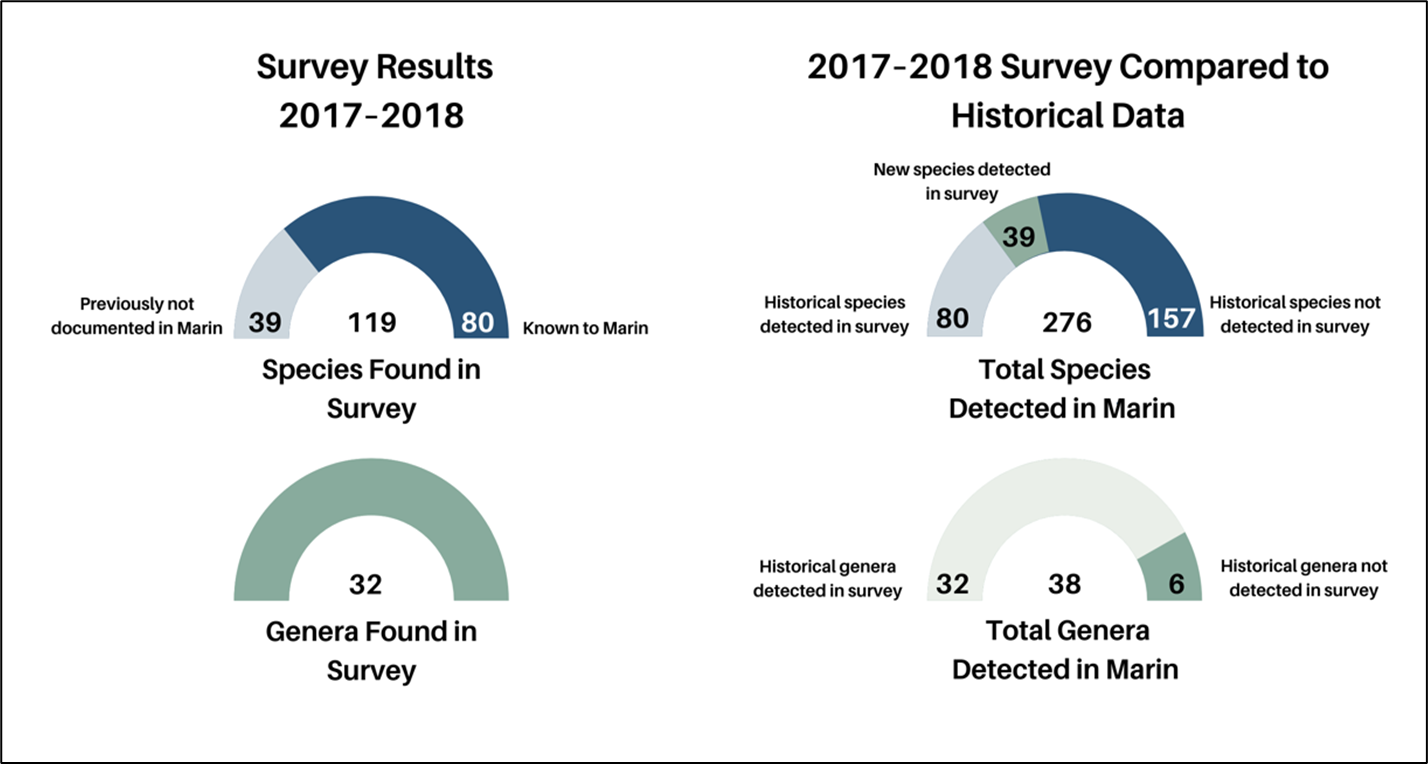
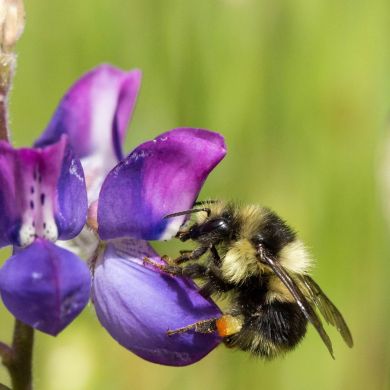
Bees were identified as an important data gap in the original 2016 Peak Health effort, which led One Tam partner agencies to begin bee studies in several locations in Marin County in 2017. Preliminary data from these surveys were used to develop metrics for the 2022 update. While it is too soon to be able to assess the condition or trend of these metrics, early signs are promising: 29% of known species and 84% of known genera were detected, and the median species richness at all sites was 36 (a remarkable recapture rate, given study limitations). In addition, 28% of known specialist species and 10 new specialist species were detected, including several that are rare or uncommon. These findings indicate that there are healthy populations of specialist host plants and suitable nesting habitat in the study area.
resources
Belsky, J., & Joshi, N. (2019). Impact of biotic and abiotic stressors on managed and feral bees. Insects, 10(8), 1- 42. https://doi.org/10.3390/insects10080233
Bommarco, R., Biesmeijer, J., Meyer, B., Potts, S. G., Pöyry, J., Roberts, S. P. M., Steffan-Dewenter, I., & Öckinger, E. (2010). Dispersal capacity and diet breadth modify the response of wild bees to habitat loss. Proceedings of the Royal Society B, 277(1690), 2075–2082. https://doi.org/10.1098/rspb.2009.2221
Cameron, S., Lozier, J., Strange, J., Koch, J., Cordes, N., Solter, L., & Griswold, T. (2011). Patterns of widespread decline in North American bumble bees. Proceedings of the National Academy of Sciences [PNAS], 108(2), 662–667. https://doi.org/10.1073/pnas.101474310
Cane, J. H., Minckley, R. L., & Kervin, L. J. (2000). Sampling bees (Hymenoptera: Apiformes) for pollinator community studies: Pitfalls of pan-trapping. Journal of the Kansas Entomological Society, 73(4), 225–231. https://www.jstor.org/stable/25085973
Cane, J. H., Minckley, R. L., Kervin, L. J., Roulston, T. H., & Williams, N. M. (2006). Complex responses within a desert bee guild (Hymenoptera: Apiformes) to urban habitat fragmentation. Ecological Applications, 16(2), 632–644. https://doi.org/10.1890/1051-0761(2006)016[0632:CRWADB]2.0.CO;2
Cane, J. H., & Tepedino, V. J. (2016). Gauging the effect of honey bee pollen collection on native bee communities. Conservation Letters, 10(2), 205–210. https://doi.org/10.1111/conl.12263
Carril, O. M., Griswold, T., Haefner, J., & Wilson, J. S. (2018). Wild bees of Grand Staircase-Escalante National Monument: Richness, abundance, and spatio-temporal beta-diversity. PeerJ, 6, e5867. https://doi.org/10.7717/peerj.5867
Colla, S. R., Otterstatter, M. C., Gegear, R. J., & Thomson, J. D. (2006). Plight of the bumble bee: Pathogen spillover from commercial to wild populations. Biological Conservation, 129(4), 461–467. https://doi.org/10.1016/j.biocon.2005.11.013
Fowler, J. (2020). Pollen specialist bees of the central United States [Website]. https://jarrodfowler.com/bees_pollen.html
Fründ, J., Zieger, S. L., & Tscharntke, T. (2013). Response diversity of wild bees to overwintering temperatures. Oecologia, 173, 1639–1648. https://doi.org/10.1007/s00442-013-2729-1
Graham, K. K., Eaton, K., Obrien, I., & Starks, P. T. (2019). Anthidium manicatum, an invasive bee, excludes a native bumble bee, Bombus impatiens, from floral resources. Biological Invasions, 21(4). https://doi.org/10.1007/s10530-018-1889-7
Graham, K. K., Gibbs, J., Wilson (Tuell), J., May, E., & Isaacs, R. (2021). Resampling of wild bees across fifteen years reveals variable species declines and recoveries after extreme weather. Agriculture, Ecosystems & Environment, 317, 107470. https://doi.org/10.1016/j.agee.2021.107470
Greenleaf, S. S., Williams, N. M., Winfree, R., & Kremen, C. (2007). Bee foraging ranges and their relationship to body size. Oecologia, 153, 589-596. https://doi.org/10.1007/s00442-007-0752-9
Grimaldi, D., & Engel, M. S. (2005). Evolution of the insects. Cambridge University Press.
Henry, M., & Rodet, G. (2018). Controlling the impact of the managed honeybee on wild bees in protected areas. Scientific Reports, 8(1), 9308. https://doi.org/10.1038/s41598-018-27591-y
Hopwood, J., Code, A., Vaughan, M., Biddinger, D., Shepherd, M., Black, S. H., Lee-Mäder, E., & Mazzacano, C. (2016). How neonicotinoids can kill bees: The science behind the role these insecticides play in harming bees (2nd ed., revised and expanded). The Xerces Society for Invertebrate Conservation. https://tinyurl.com/ypzpcz4k
Kammerer, M., Goslee, S. C., Douglas, M. R., Tooker, J. F., & Grozinger, C. M. (2021). Wild bees as winners and losers: Relative impacts of landscape composition, quality, and climate. Global Change Biology, 27(6), 1250–1265. https://doi.org/10.1111/gcb.15485
Koch, J., Strange, J., & Williams, P. (2012). Bumble bees of the western United States. (USDA Forest Service Research Notes, Publication no. FS-972). U.S. Department of Agriculture. https://tinyurl.com/yc6kh494
Kopit, A. M., & Pitts-Singer, T. L. (2018). Routes of pesticide exposure in solitary, cavity-nesting bees. Environmental Entomology, 47(3), 499–510. https://doi.org/10.1093/ee/nvy034
Kuhlman, M. P., Burrows, S., Mummey, D. L., Ramsey, P. W., & Hahn, P. G. (2021). Relative bee abundance varies by collection method and flowering richness: Implications for understanding patterns in bee community data. Ecological Solutions and Evidence, 2(2), e12071.https://doi.org/10.1002/2688-8319.12071
LeBuhn, G. (2022). One Tam pollinators survey. Tamalpais Lands Collaborative (One Tam).
LeBuhn, G., Droege, S., Connor, E. F., Gemmill-Herren, B., Potts, S. G., Minckley, R. L., Griswold, T., Jean, R., Kula, E., Roubik, D., Cane, J., Wright, K. W., Frankie, G., & Parker, F. (2012). Detecting insect pollinator declines on regional and global scales. Conservation Biology, 27(1), 113–120. https://doi.org/10.1111/j.1523-1739.2012.01962.x
Meiners, J. M., Griswold, T. L., & Carril, O. M. (2019). Decades of native bee biodiversity surveys at Pinnacles National Park highlight the importance of monitoring natural areas over time. PLoS ONE, 14(1), e0207566. https://doi.org/10.1371/journal.pone.0207566
Memmott, J., Craze, P. G., Waser, N. M., & Price, M. V. (2007). Global warming and the disruption of plant-pollinator interactions. Ecology Letters, 10(8), 710–717. https://doi.org/10.1111/j.1461-0248.2007.01061.x
Minckley, R. L., Roulston, T. H., & Williams, N. M. (2013). Resource assurance predicts specialist and generalist bee activity in drought. Proceedings of the Royal Society of London B, 280(1759), 20122703. https://doi.org/10.1098/rspb.2012.2703
Montero-Castaño, A., Koch, J. B. U., Lindsay, T. T., Love, B., Mola, J. M., Newman, K., & Sharkey, J. M. (2022). Pursuing best practices for minimizing wild bee captures to support biological research. Conservation Science and Practice, 4(7), e12734. https://doi.org/10.1111/csp2.12734
Orr, M.C., Hughes, A.C., Chesters, D., Pickering, J., Zhu, C., & Ascher, J. S. (2021). Global patterns and drivers of bee distribution. Current Biology, 31, 451–458. https://doi.org/10.1016/j.cub.2020.10.053
Packer, L., & Darla-West, G. (2021). Bees: How and why to sample them. In J. C. Santos & G. W. Fernandes (Eds.), Measuring arthropod biodiversity (pp. 55–83). Springer. https://doi.org/10.1007/978-3-030-53226-0_3
Pardee, G. L., Griffin, S. R., Stemkovski, M., Harrison, T., Portman, Z. M., Kazenel, M. R., Lynn, J. S., Inouye, D. W., & Irwin, R. E. (2022). Life-history traits predict responses of wild bees to climate variation. Proceedings of the Royal Society B, 289(1973), 20212697. https://doi.org/10.1098/rspb.2021.2697
Portman, Z. M., Bruninga-Socolar, B., & Cariveau, D. P. (2020). The state of bee monitoring in the United States: A call to refocus away from bowl traps and towards more effective methods. Annals of the Entomological Society of America, 113(5), 337–342. https://doi.org/10.1093/aesa/saaa010
Potts, S. G., Biesmeijer, J. C., Kremen, C., Neumann, P., Schweiger, O., & Kunin, W. E. (2010). Global pollinator declines: Trends, impacts and drivers. Trends in Ecology & Evolution, 25(6), 345–353. https://doi.org/10.1016/j.tree.2010.01.007
Pyke, G. H., Thomson, J. D., Inouye, D. W., & Miller, T. J. (2016). Effects of climate change on phenologies and distributions of bumble bees and the plants they visit. Ecosphere, 7(3), e01267. https://doi.org/10.1002/ecs2.1267
Schweiger, O., Biesmeijer, J. C., Bommarco, R., Hickler, T., Hulme, P. E., Klotz, S., Kühn, I., Moora, M., Nielsen, A., Ohlemüller, R., Petanidou, T., Potts, S. G., Pyšek, P., Stout, J. C., Sykes, M., Tscheulin, T., Strange, J. P., Koch, J. B., Gonzalez, V. H., Nemelka, L., & Griswold, T. (2011). Global invasion by Anthidium manicatum (Linnaeus) (Hymenoptera: Megachilidae): Assessing potential distribution in North America and beyond. Biological Invasions, 13, 2115–2133. https://doi.org/10.1007/s10530-011-0030-y
Stuligross, C., & Williams, N. M. (2020). Pesticide and resource stressors additively impair wild bee reproduction. Proceedings of the Royal Society B, 287(1935), 20201390. https://doi.org/10.1098/rspb.2020.1390
Tepedino, V. J., Durham, S., Cameron, S. A., & Goodell, K. (2014). Documenting bee decline or squandering resources. Conservation Biology, 29(1), 280–282. https://doi.org/10.1111/cobi.12439
Thompson, A., Frenzel, M., Schweiger, O., Musche, M., Groth, T., Roberts, S. P. M., Kuhlmann, M., & Knight, T. M. (2021). Pollinator sampling methods influence community patterns assessments by capturing species with different traits and at different abundances. Ecological Indicators, 132, 108284.https://doi.org/10.1016/j.ecolind.2021.108284
Vilà, M., Walther, G. R., Westphal, C., & Settele, J. (2010). Multiple stressors on biotic interactions: How climate change and alien species interact to affect pollination. Biological Reviews of the Cambridge Philosophical Society, 85(4), 777–795. https://doi.org/10.1111/j.1469-185X.2010.00125.x
, , & (2022). Effects of short-term managed honey bee deployment in a native ecosystem on wild bee foraging and plant–pollinator networks. Insect Conservation and Diversity, 15(5), 634–644. https://doi.org/10.1111/icad.12594
Williams, N. M., Minckley, R. L., & Silveira, F. A. (2001). Variation in native bee faunas and its implications for detecting community changes. Conservation Ecology, 5(1). https://doi.org/10.5751/ES-00259-050107
Woodard, S. H., Federman, S., James, R. R., Danforth, B. N., Griswold, T. L., Inouye, D., McFrederick, Q. S., Morandin, L., Paul, D. L., Sellers, E., Strange, J. P., Vaughan, M., Williams, N. M., Branstetter, M. G., Burns, C. T., Cane, J., Cariveau, A. B., Cariveau, D. P., Childers, A., … Wehling, W. (2020). Towards a U.S. national program for monitoring native bees. Biological Conservation, 252, 108821. https://doi.org/10.1016/j.biocon.2020.108821
Xerces Society. (n.d.). The Wilsonville bee kill. https://xerces.org/wilsonville-bee-kill